


Quick answer: Pick the tonnage from your room size and how much sun it gets: about 1 ton for a small room, 1.5 ton for a medium one, 2 ton for a large one. Then compare ACs by the units a year printed on the BEE label, not by stars alone. Yearly running cost = label units × your rate per unit. A label showing 800 units costs about Rs 5,600 a year at Rs 7 a unit.
As an Amazon Associate, this site earns from qualifying purchases. Some links on this page are affiliate links; the price you pay does not change.
An AC can be the biggest single user of electricity in a home in summer, so the choice matters twice: once at the shop and again every month on your bill. This guide takes you through it in four steps: size, efficiency label, running cost and the temperature you set.
Facts were checked on 25 October 2026. The BEE rules for split ACs changed on 1 January 2026, so some older articles you find online are out of date. Where the sources disagree, this guide says so instead of picking one.

On this page
- Step 1: Pick the right tonnage
- Step 2: Read the BEE label, not just the stars
- Step 3: Work out the running cost
- Step 4: Set the temperature sensibly
- Inverter or non-inverter?
- Examples on Amazon India
- Split or window AC?
- Care that keeps the bill down
- Common mistakes
- Checklist before you buy
- Frequently asked questions
- Sources
Step 1: Pick the right tonnage
Tonnage is the cooling power of the AC. One ton is about 3.5 kW of cooling. A bigger number cools a bigger space. Makers publish room-size guides, and they are not identical. Here are two of them side by side.
| Room size | Haier guide | LG guide |
|---|---|---|
| Up to about 120 sq ft | 1 ton (up to 150 sq ft) | 1 ton (up to 120 sq ft) |
| 120 to 180 sq ft | 1 ton up to 150 sq ft, then 1.5 ton | 1.5 ton |
| 180 to 250 sq ft | 1.5 ton (151 to 250 sq ft) | 2 ton (180 to 240 sq ft) |
| 250 to 400 sq ft | 2 ton (251 to 400 sq ft) | 2 ton or more (240 sq ft and above) |
The gap between the two is real: for a 200 sq ft room, Haier says 1.5 ton and LG says 2 ton. So treat the table as a range, then adjust for your own room.
When to go one size up
- The room gets direct afternoon sun, especially from a south or west window. Haier suggests adding 10 to 20 percent. LG says to go one size up.
- It is the top floor, or you live in a very hot, dry city. LG says to go one size up for these.
- More than two people use the room. Haier adds about 0.1 ton for each extra person.
- The room has large single-glass windows, or a lot of equipment and lighting. Haier adds about 0.5 ton for each.
- The ceiling is higher than 8 to 9 feet. Haier adds about 10 percent.
Measure length × width in feet to get the area. If the shop assistant guesses the tonnage without asking about the floor, the sun and the windows, ask again. A heat-load estimate from the dealer or brand is better than a rule of thumb.
Step 2: Read the BEE label, not just the stars
Every split AC sold in India carries a Bureau of Energy Efficiency (BEE) label with 1 to 5 stars. The stars come from a number called ISEER (Indian Seasonal Energy Efficiency Ratio). A higher ISEER means the AC delivers more cooling for each unit of electricity. BEE measures it across a range of outdoor temperatures from 24 to 43 °C and assumes 1,600 hours of cooling a year.
The rules changed on 1 January 2026
The Ministry of Power notified a revision on 28 August 2025 (S.O. 3984(E)). A legal-update summary of it says the new label period for split ACs runs from 1 January 2026 to 31 December 2027. Thresholds for each star were raised, so an AC that was 5-star in 2024 may be 4-star now.
Published summaries of the new cut-offs disagree: one maker says a 2026 5-star split AC needs an ISEER of 5.2 or higher, another says 5.6 or higher. Because of that, do not compare stars across different years. Compare the ISEER and the units a year printed on the label of the AC you are buying, and check the label period on it.
For reference, here are the cut-offs for split inverter ACs in the earlier period (1 July 2022 to 31 December 2024). They show how much one star is worth, but they are not the 2026 numbers.
| Stars | ISEER, 2022 to 2024 period |
|---|---|
| 1 star | 3.30 to 3.49 |
| 2 stars | 3.50 to 3.79 |
| 3 stars | 3.80 to 4.39 |
| 4 stars | 4.40 to 4.99 |
| 5 stars | 5.00 and above |

Step 3: Work out the running cost
The label prints the units (kWh) the AC uses in a year. Multiply by your rate per unit:
Yearly running cost (Rs) = label units a year × rate per unit
Rates differ by state and by how many units you use in a month, so your own bill is the best guide. Here are three typical label figures at three rates.
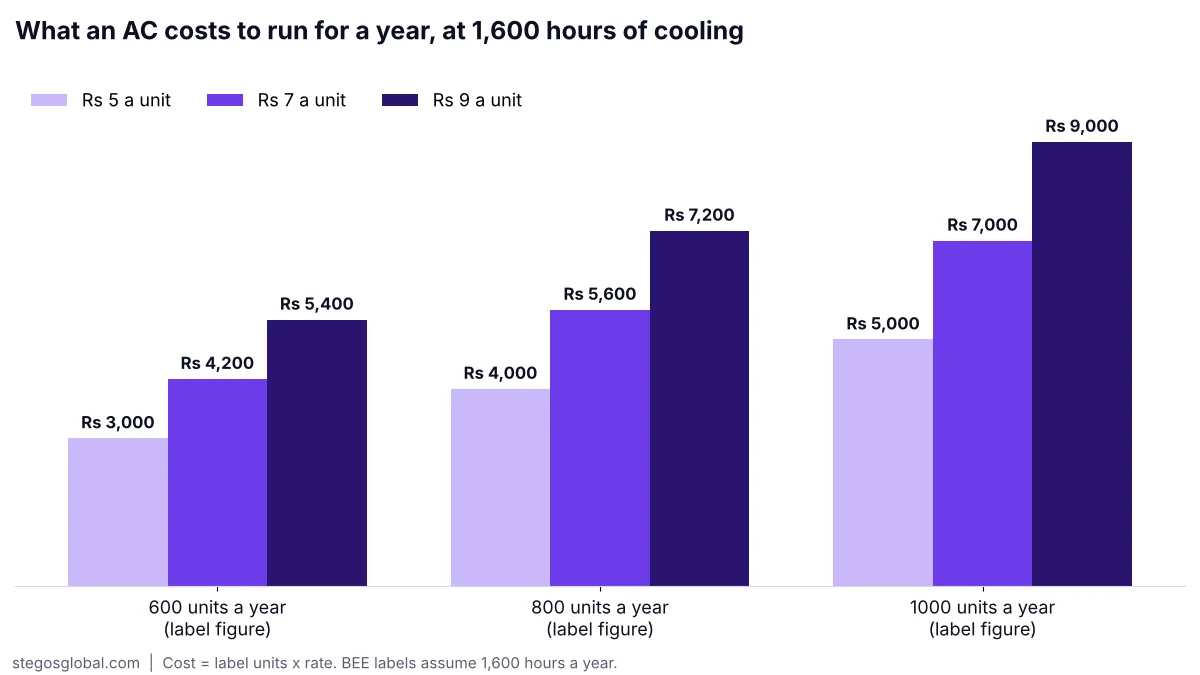
| Label units a year | At Rs 5/unit | At Rs 7/unit | At Rs 9/unit |
|---|---|---|---|
| 600 | Rs 3,000 | Rs 4,200 | Rs 5,400 |
| 800 | Rs 4,000 | Rs 5,600 | Rs 7,200 |
| 1,000 | Rs 5,000 | Rs 7,000 | Rs 9,000 |
Adjust for how long you really run it
1,600 hours is about 6.7 hours a day for 240 days. If you run the AC 5 hours a day for 240 days, that is 1,200 hours, so your cost is 1,200 ÷ 1,600 = 75 percent of the label figure. A bedroom AC used only at night in a cooler city may use far less than the label. A shop or home office in a hot city may use more.
Use the calculator to compare two ACs. It scales the label units to your hours and tells you how many years the dearer, more efficient AC takes to pay for itself. The prices and label units already in the boxes are only an example. Replace them with the numbers from the shop.
Step 4: Set the temperature sensibly
Since 2020, BEE has required star-rated ACs to ship with the thermostat default set to 24 °C. Lowering it costs more. Makers told BEE that energy use rises about 6 percent for each degree below 22 °C and about 4 to 5 percent between 24 and 26 °C. A researcher at WRI India told ThePrint the real figure is roughly 3 to 6 percent a degree, depending on the room and the load.
In June 2025 the power minister proposed limiting new ACs to a 20 to 28 °C range. As of the ThePrint report in September 2025 it had not been made a rule. Check before you rely on it.
Inverter or non-inverter?
An inverter AC changes its compressor speed to hold the room temperature, instead of switching the compressor fully on and off. Both types get a BEE label, and ISEER already counts how each behaves across a season, so the label units are the fair way to compare them.
Examples on Amazon India
These are examples from Amazon India search results for 1 ton and 1.5 ton inverter split ACs, not a ranking, and we have not tested them. The star count comes from the listing title. ISEER, annual energy and capacity are what each listing's specification table says, read on 27 October 2026. Check the label on the AC itself before you buy.
| AC (listing) | Capacity | Stars in title | ISEER in listing | Annual energy in listing |
|---|---|---|---|---|
| Panasonic 1 Ton | 1 ton | 3 | 4.50 | 576.31 kWh |
| Cruise 1 Ton | 1 ton | 3 | 4.41 | 604.99 kWh |
| Lloyd 1 Ton | 1 ton | 3 | 4.47 | 606.39 kWh |
| Daikin 1 Ton | 1 ton | 3 | 4.40 | 619.31 kWh |
| Lloyd 1.5 Ton | 1.5 ton | 5 | 5.75 | 646.32 kWh |
| Panasonic 1.5 Ton | 1.5 ton | 5 | 5.80 | 681.01 kWh |
| Godrej 1.5 Ton | 1.5 ton | 5 | 5.1 | 728.31 kWh |
| Daikin 1.42 Ton | 1.42 ton | 4 | 5.15 | 751.22 kWh |
| Voltas 1.5 Ton | 1.5 ton | 5 | See listing | 751.28 kWh |
| Daikin 1.42 Ton | 1.42 ton | 3 | 4.40 | 880.1 kWh |
Look at the Godrej 5-star and the Daikin 4-star rows: their ISEER values are close (5.1 and 5.15), yet the stars differ. Listings may follow different label periods, which is one more reason to read the label on the unit and not compare stars alone. At Rs 7 a unit, the gap between 576 kWh and 751 kWh is 175 units, or about Rs 1,225 a year, so size and ISEER both matter. Annual energy is for the label's 1,600 hours, so the true bill depends on your hours.
Amazon Associate disclosure: as an Amazon Associate we earn from qualifying purchases. This does not change the price you pay.
Split or window AC?
| Split | Window | |
|---|---|---|
| Installation | Indoor and outdoor unit with pipes, needs a wall space for the outdoor unit | One box fitted in a wall or window opening |
| Noise indoors | Quieter, the compressor is outside | Louder, the compressor is in the room |
| Price | Usually higher | Usually lower |
| Best for | Bedrooms, living rooms, long daily use | Rented rooms, small spaces, short seasonal use |
Both carry BEE labels, so compare the units a year printed on each. A window AC is fine for a rented room if you cannot drill into walls.
Care that keeps the bill down
- Clean or rinse the indoor filter every few weeks in the cooling season. A choked filter makes the AC work harder.
- Get the outdoor unit serviced before summer and keep it in shade with open space around it.
- Close doors and windows, and draw curtains on sun-facing windows.
- Use a ceiling fan with the AC so you can set the thermostat a degree or two higher.
- Switch the AC off at the wall when you are away for weeks.
Common mistakes
- Buying by star count alone and ignoring the room size and the label period.
- Choosing a unit too big for the room. It cools fast, switches off early and may feel clammy.
- Setting 16 °C. It uses more electricity, and the room does not cool faster.
- Skipping the installation charges and pipe-length limit when comparing offers.
This guide is general information. For safe installation and gas or wiring work, use the brand's authorised technician.
Checklist before you buy
- Measure the room and note the floor, the sun and the windows. Choose the tonnage from those, not from the shop display.
- Read the label on the actual unit: ISEER, units a year and label period (it should start in 2026).
- Ask for the price difference between the two AC models you are choosing between.
- Divide the price difference by the yearly saving from the calculator. A payback of a few years is good if you use the AC a lot.
- Ask what the installation charges and the pipe length allowance are. These can add to the cost.
- Keep the bill and the warranty card, and note the warranty terms for the compressor and the rest of the AC.
Frequently asked questions
Is 1.5 ton enough for a 150 sq ft room?
Usually yes. Haier suggests 1 ton up to 150 sq ft and 1.5 ton above that. LG suggests 1.5 ton from 120 sq ft. If the room is on a top floor or gets afternoon sun, 1.5 ton is the safer choice.
Is a 5-star AC always worth the extra price?
Not always. It pays off when you run the AC for many hours a year. Use the calculator with your own hours and rate. If the payback is longer than you plan to keep the AC, a lower star can be the better buy.
Does setting 24 °C really save electricity?
Yes, but the saving per degree is modest and depends on the room. The sources above put it at about 3 to 6 percent a degree.
Why does my bill look higher than the label figure?
The label assumes 1,600 hours of cooling at standard test conditions. If you run the AC for more hours, in a hotter room, or with the door open, you will use more. The fans, lights and fridge in the same house also add to the bill.
Which is better, 1.5 ton or 2 ton for a 200 sq ft room?
The two maker guides in this article differ: Haier says 1.5 ton for 151 to 250 sq ft, and LG says 2 ton for 180 to 240 sq ft. A room with sun, a top floor or several people points to the larger size.
Is an inverter AC always cheaper to run?
Not always. An inverter AC adjusts compressor speed, and the BEE label already counts how each type behaves across a season. Compare the units a year on the labels.
How often should I service my AC?
Brand manuals usually advise a service before each cooling season, and a filter clean every few weeks while it runs. Check your manual for the exact schedule.
Can I compare stars between an old and new AC?
Not reliably. Thresholds changed on 1 January 2026, so compare ISEER and the units a year on the labels.
Sources
View sources (6)
| Source | What it was used for |
|---|---|
| Haier India, "How to calculate the perfect AC tonnage for your room" haier.com | room size to tonnage and adjustments (checked 25 October 2026). |
| LG India, "Which AC capacity do you actually need" lg.com | room size guide, going one size up (checked 25 October 2026). |
| Complinity, "Ministry of Power issues notification for amendments in BEE star rating period for air conditioners" complinity.com | S.O. 3984(E), 28 August 2025 and label periods (legal-update summary of the notification). |
| Optimist, "Which ISEER rating is good for AC" optimist.in | 2022 to 2024 ISEER cut-offs for split inverter ACs, test method with 1,600 hours. |
| Onida, "AC star rating 2026: new BEE standards explained" onida.com | one maker's view of the 2026 changes; 1,600 hours label assumption. |
| ThePrint, "India AC temp is 24 C: net zero mission" theprint.in | BEE 24 °C default since 2020, saving per degree, June 2025 proposal (15 September 2025). |