

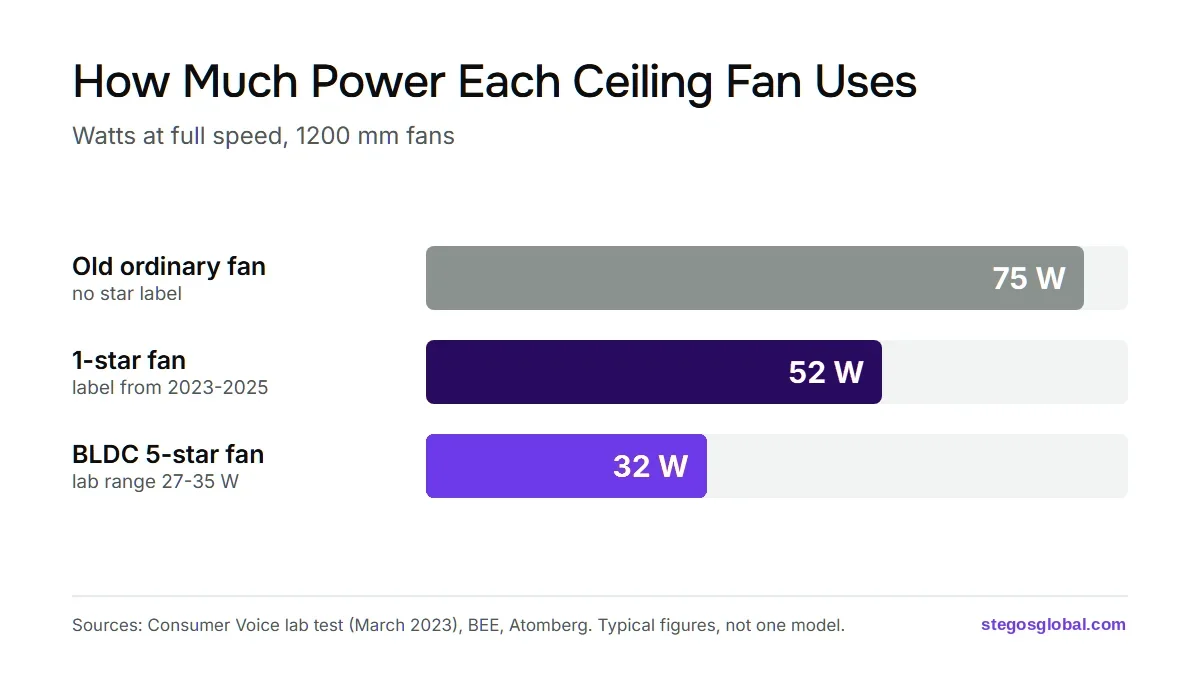
Quick answer: A BLDC ceiling fan uses about 26-35 watts at full speed. An older ordinary fan uses about 70-75 watts. Replace an old fan that runs 12 hours a day and you save about 155 units of electricity a year. At Rs 7 a unit, that’s about Rs 1,080 a year for each fan.
As an Amazon Associate, this site earns from qualifying purchases. Some links on this page are affiliate links; the price you pay does not change.
The saving is smaller if your current fan is fairly new. Ceiling fans in India now carry a BEE star label, and even 1-star fans use about 50 watts. Swapping one of those for a BLDC fan saves about Rs 500 a year on the same use.
This guide shows your saving for different hours and electricity rates. It also covers lab test results, the new 2026 star ratings, backup during power cuts and the right fan size for your room. It also explains when switching isn’t worth the money.
On this page
- Find your saving in the table
- What it means for your monthly bill
- Why fans matter so much on an Indian bill
- BLDC fan vs ordinary fan at a glance
- What BLDC fans really use: independent lab results
- Why a BLDC fan uses less power
- What the BEE star rating on a fan means
- How BLDC fans help during power cuts
- BLDC fans in areas with low or unstable voltage
- Remote or regulator: which BLDC fan to pick
- What new BLDC fan owners notice
- Are BLDC fans quieter?
- Choose the right fan size for your room
- When a BLDC fan is worth it
- When it might not be worth it
- What to check before you buy
- Installing a BLDC fan safely
- Questions people ask
- Sources
Find your saving in the table
These figures compare a 32-watt BLDC fan with two common fans. They assume the fan runs 300 days a year. Most of India uses fans for most of the year, but less in winter.
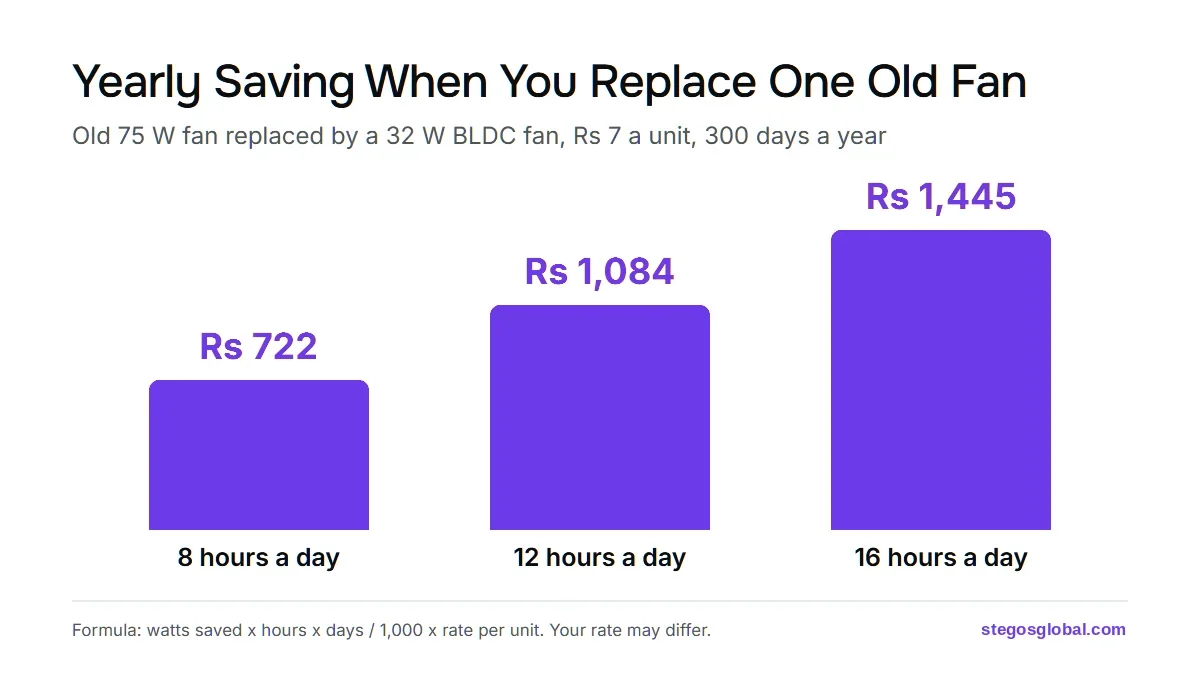
Replacing an old fan (75 watts, usually bought before 2022). You save 43 watts:
| Hours a day | Units saved a year | At Rs 5/unit | At Rs 7/unit | At Rs 9/unit |
|---|---|---|---|---|
| 8 hours | 103 | Rs 516 | Rs 722 | Rs 929 |
| 12 hours | 155 | Rs 774 | Rs 1,084 | Rs 1,393 |
| 16 hours | 206 | Rs 1,032 | Rs 1,445 | Rs 1,858 |
Replacing a 1-star fan labelled before 2026 (52 watts). You save 20 watts:
| Hours a day | Units saved a year | At Rs 5/unit | At Rs 7/unit | At Rs 9/unit |
|---|---|---|---|---|
| 8 hours | 48 | Rs 240 | Rs 336 | Rs 432 |
| 12 hours | 72 | Rs 360 | Rs 504 | Rs 648 |
| 16 hours | 96 | Rs 480 | Rs 672 | Rs 864 |
Most homes have more than one fan. Three old fans running 12 hours a day at Rs 7 a unit add up to about Rs 3,250 a year.
Work out your own number
Use this formula:
Yearly saving (Rs) = watts saved × hours a day × days a year ÷ 1,000 × your rate per unit
For example: 43 watts × 12 hours × 300 days ÷ 1,000 = 154.8 units. Then 154.8 × Rs 7 = Rs 1,084.
To find your fan’s watts, read the BEE star label on the fan motor or box. It lists “Power input (watts)”. For an old fan with no label, check the sticker on the motor, or use 75 watts as a fair guess.
Normal fan
- Power used
- –
- Cost a month
- –
- Cost a year
- –
BLDC fan
- Power used
- –
- Cost a month
- –
- Cost a year
- –
Costs are energy charges only, worked out at the slab your extra units fall in. Fixed charges, electricity duty, fuel surcharges and taxes come on top, and tariffs change every year. Your own bill is the final word.
What it means for your monthly bill
Electricity bills in India come every month or every two months, so it helps to see the saving that way.
One old fan running 12 hours a day uses about 27 units a month. A BLDC fan uses about 11.5 units for the same time. That’s about 15.5 units saved each month, for every fan you replace. Three fans save about 46 units a month.
This matters more than it looks, because most states charge in slabs. The more units you use, the higher the rate for the last units. The units you save come off your most expensive slab first. So your real saving per unit is your top slab rate, not your average rate.
Saving 46 units a month can also pull your bill back into a cheaper slab. If your bill is just over a slab limit in summer, that’s an extra saving.
Find your rate per unit
Your rate depends on your state, your electricity company and how much you use. There are two ways to find it:
- Quick estimate: divide your last bill’s total amount by the units used. If your bill was Rs 2,450 for 350 units, your average rate is Rs 7 a unit.
- More exact: find your highest slab on the bill or your electricity company’s tariff page, and use that rate. That’s the rate your saved units are charged at.
Here is one example from an official tariff order for 2026-27. It shows energy charges only. Fixed charges, electricity duty and fuel charges come on top.
| State | Domestic energy charges, 2026-27 |
|---|---|
| Chhattisgarh (from 1 July 2026) | Rs 4.40 a unit up to 100 units; Rs 4.50 for 101-200; Rs 6.00 for 201-400; Rs 7.00 for 401-600; Rs 8.80 above 600 |
A family in Chhattisgarh using 250 units a month pays Rs 6.00 for its top units. Rates differ a lot between states, which is why the calculator above asks for your state. The Rs 7 column in the tables is a middle figure.
Why fans matter so much on an Indian bill
Fans are easy to ignore because each one uses so little. But there are a lot of them, and they run for hours.
Prayas Energy Group, a Pune research group, looked at this in 2023. It found that about 88% of Indian homes own a ceiling fan. Ceiling fans make up about 40% of all household electricity use in India. It also estimates that 3-4 crore new fans are added every year.
For your home, this means a 40-watt saving on each fan adds up quickly across a long summer.
BLDC fan vs ordinary fan at a glance
| Ordinary (induction) fan | BLDC fan | |
|---|---|---|
| Power at full speed | About 55-80 W, depending on age | About 26-35 W |
| Star rating | Usually 1 star | 5 star |
| Speed control | Wall regulator | Remote, or its own regulator |
| When voltage drops | Slows down | Speed stays steady within its voltage range |
| On an inverter | Normal backup | About twice the backup |
| Noise | Motor hum | 5-10 decibels quieter |
| Starting part | Needs a capacitor | Electronic circuit, no capacitor |
The power figures come from Orient Electric, Atomberg and the Consumer Voice lab test. The star rating line comes from Prayas Energy Group’s analysis of BEE data. The rest comes from Orient Electric’s BLDC fan FAQ, so treat it as one maker’s description.
What BLDC fans really use: independent lab results
Fan makers quote their own figures, so it helps to see an independent test. In March 2023, Consumer Voice tested four BEE 5-star BLDC fans of 1200 mm size. The tests were done at an accredited laboratory under the Indian standard IS 374:2019. The report is published on the Department of Consumer Affairs website.
The results:
- All four fans used between 26.9 and 35.42 watts. The lowest was the Havells Efficiencia NEO at 26.9 watts, followed by the Atomberg Efficio at 27.93 watts.
- All four met the minimum air delivery for a 1200 mm fan, which is 210 cubic metres a minute. Three of them measured above 224.
- All four passed the safety tests, including leakage current, endurance and a locked-motor test.
The same report notes that a 1200 mm fan should draw no more than about 50 watts under the Indian standard. That’s why 1-star fans sit around 50 watts, and why old fans at 70-75 watts are well outside today’s rules.
What this means for you: the “about 30 watts” figure holds up in lab tests. BLDC fans also didn’t give less air than the minimum the standard demands. You’re not trading breeze for savings.

Why a BLDC fan uses less power
BLDC stands for brushless direct current. It’s a different kind of motor:
- Ordinary fans use an induction motor. It runs straight off the AC mains and loses a lot of energy as heat.
- BLDC fans use permanent magnets and a small electronic circuit. The circuit turns AC into DC and controls the motor precisely. Less energy is lost, so the fan moves the same air for less than half the power.
Old regulators waste power too. Ordinary fans are slowed down by capacitor or resistor-based regulators. Consumer Voice notes that some energy is lost in the regulator itself. BLDC fans change speed electronically, through a remote or their own regulator, so this loss mostly goes away.
According to Prayas Energy Group, all 5-star ceiling fans on BEE’s list use BLDC motors, and induction fans are 1-star. The BEE label itself states the motor type (“Induction” or “BLDC”), so you can check before you buy.
What the BEE star rating on a fan means
The star rating is based on service value: how much air the fan moves (cubic metres per minute) for each watt it uses. More stars means more air for each unit of electricity.
The rules got stricter on 1 January 2026. Here are the official tables for fans with a sweep above 1050 mm and up to 1500 mm. That group covers the common 1200 mm and 1400 mm sizes.
| Stars | Service value until 31 December 2025 | Service value from 1 January 2026 to 31 December 2028 |
|---|---|---|
| 1 star | 4.0 to under 4.5 | 4.5 to under 5.0 |
| 2 stars | 4.5 to under 5.0 | 5.0 to under 5.5 |
| 3 stars | 5.0 to under 5.5 | 5.5 to under 6.0 |
| 4 stars | 5.5 to under 6.0 | 6.0 to under 6.5 |
| 5 stars | 6.0 or more | 6.5 or more |
Source: Ministry of Power notifications S.O. 246(E) of 17 January 2024 and S.O. 3471(E) of 14 August 2024, Gazette of India.
Here’s what the new table means in watts. A 1200 mm fan must deliver at least 210 cubic metres of air a minute. At that air delivery:
- a 1-star fan from 2026 can use no more than about 47 watts (210 ÷ 4.5)
- a 5-star fan from 2026 can use no more than about 32 watts (210 ÷ 6.5)
Fans that move more air are allowed a few more watts for the same stars. In the Consumer Voice test, the best BLDC fans reached a service value above 8. That’s well past the new 5-star line.
So a fan labelled 1-star in 2026 should use less power than a 1-star fan from 2023. The 52-watt figure in our second table is for 1-star fans labelled before 2026.
How to read the label in a shop
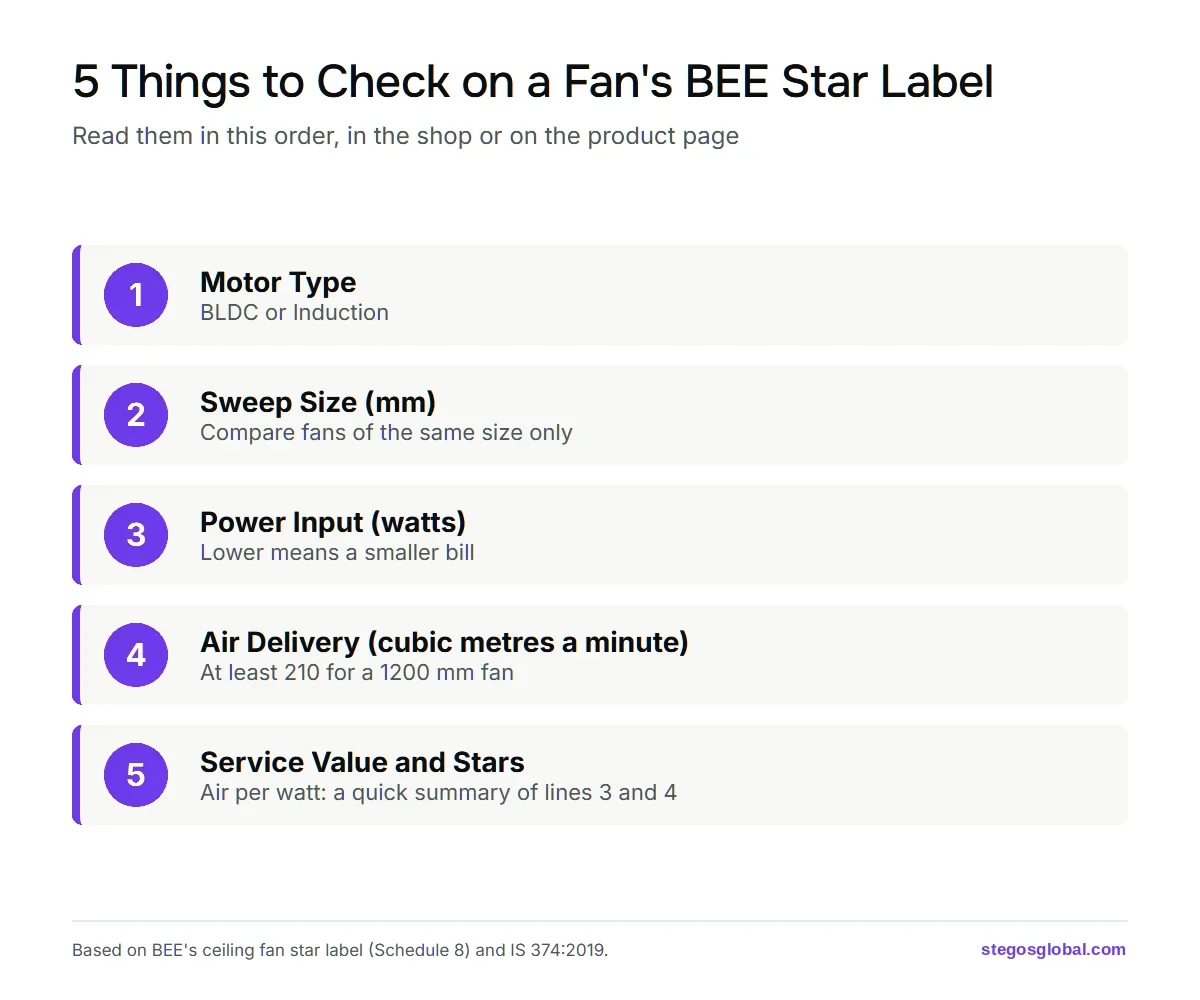
The BEE label is stuck on the fan motor or printed on the box. Check these lines, in this order:
- Motor type: “BLDC” or “Induction”.
- Sweep size (mm): the blade span. Compare fans of the same size only.
- Power input (watts): lower means a smaller bill.
- Air delivery (cubic metres a minute): higher means a stronger breeze. For 1200 mm, it must be at least 210.
- Service value and stars: a quick summary of the two lines above.
Tip: the stars matter less than the watts and air delivery. Two 5-star fans can differ by several watts. Compare those two lines directly.
Buying online? Find the label first
Product pages often leave the star label out. In 2023, Prayas Energy Group checked 181 ceiling fan listings online. About two-thirds didn’t show star label details.
Before you buy online, look through the product photos for the BEE label. If it isn’t there, check the brand’s own product page or ask the seller. Don’t rely on “energy saving” in the title.
How BLDC fans help during power cuts
If your home has an inverter (home UPS), BLDC fans make the battery last much longer. Orient Electric says its BLDC fans run about twice as long on an inverter as induction fans, because they draw about half the power.
Battery makers use this formula for backup time:
Backup hours = battery Ah × battery voltage × inverter efficiency ÷ load in watts
Take a common 150Ah, 12-volt battery. That’s 1,800 watt-hours on paper. Livguard’s guide says most inverters run at 90-95% efficiency. DesiUtility’s calculator uses a more careful 85% for tubular batteries, which gives about 1,530 watt-hours. It also notes that after 2-3 years, a tubular battery may hold only 70-80% of its capacity. At 80%, that’s about 1,220 watt-hours.
| What’s running | Total power | New battery (about 1,530 Wh) | After 2-3 years (about 1,220 Wh) |
|---|---|---|---|
| 3 old fans (75 W each) | 225 W | about 6.8 hours | about 5.4 hours |
| 3 BLDC fans (32 W each) | 96 W | about 15.9 hours | about 12.8 hours |
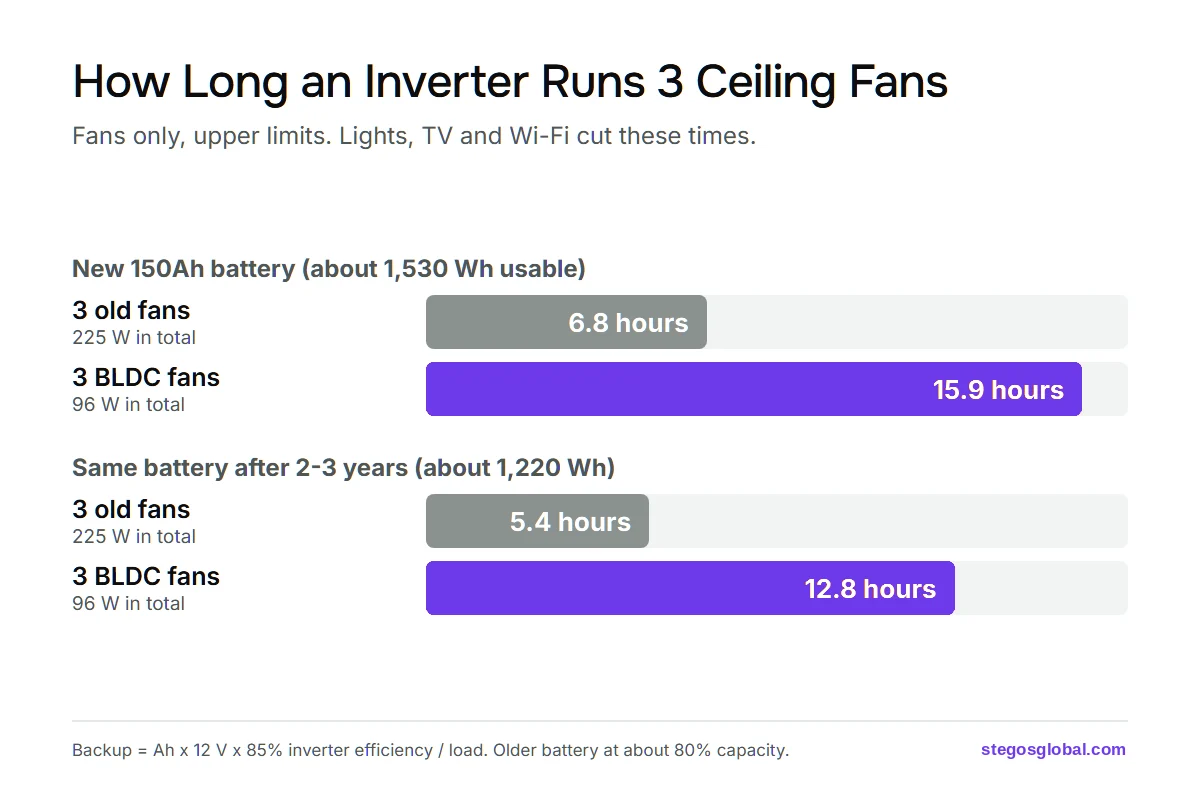
Treat these as upper limits. Lights, a Wi-Fi router and a TV draw power too. DesiUtility’s guide also advises using only part of a tubular battery’s charge, to protect its life. The point is the difference: the same battery keeps BLDC fans running more than twice as long.
BLDC fans in areas with low or unstable voltage
In many towns, the voltage drops in the evening. An ordinary fan slows down when this happens.
Orient Electric says the speed of its BLDC fans doesn’t change when voltage fluctuates. It rates its remote models for 120-280 volts and its regulator models for 140-270 volts. Other brands publish their own ranges. Check the voltage range on the product page if your area has frequent drops.
Remote or regulator: which BLDC fan to pick
BLDC fans come in two types:
- Remote models work only with the remote. Your old wall regulator must be bypassed when the fan is installed. If it isn’t, the fan may not respond to the regulator.
- Regulator models come with their own regulator, or work with standard step regulators. Pick one of these if you prefer a switch on the wall.
Orient Electric’s FAQ confirms both points for its own fans. Other brands sell both types too. Check which one you’re buying.
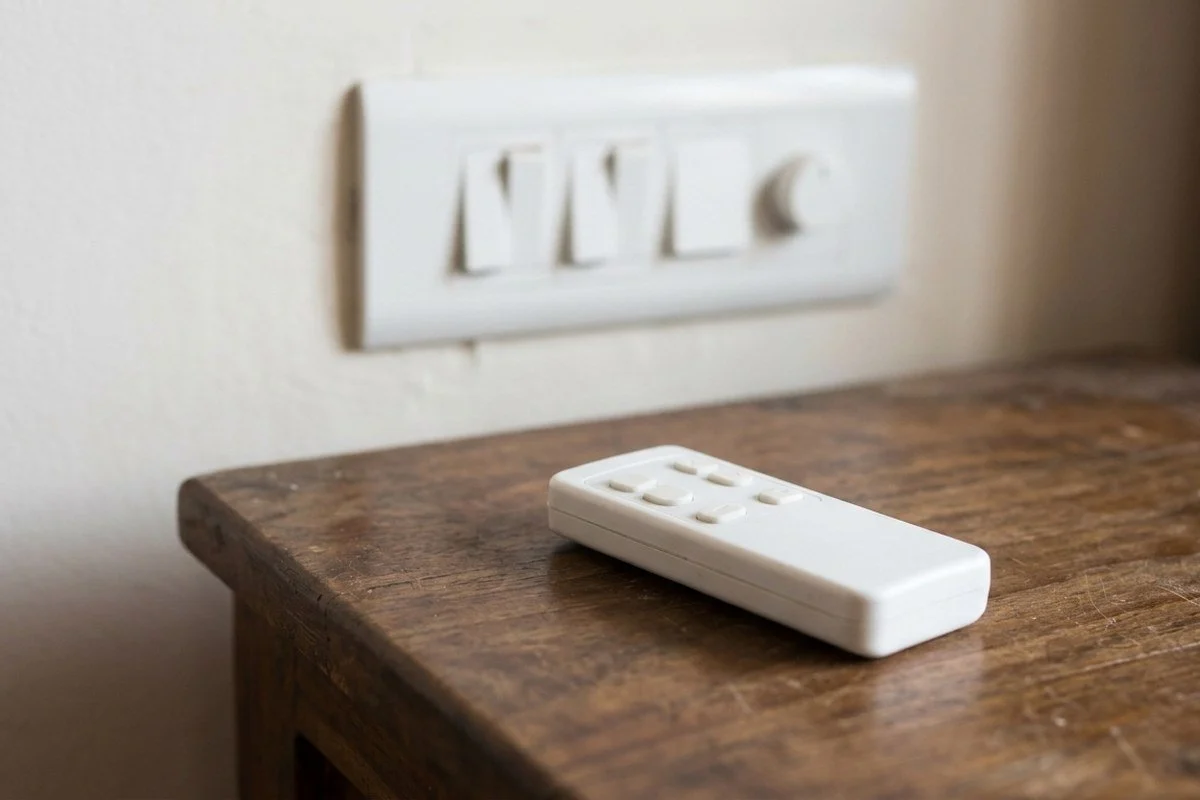
When the electrician installs a remote model, ask them to bypass the old regulator and connect the fan straight to the switch. Keep the remote somewhere fixed. A wall holder helps, and most remotes run on standard batteries.
Some models let one remote control several fans, and some don’t. Orient’s FAQ lists both kinds in its range. If you want one remote for a room with two fans, check the product page first.
What new BLDC fan owners notice
A few things about BLDC fans surprise people the first week. Orient Electric’s FAQ explains them:
- A small jerk at start-up is normal. The motor’s magnets line up before it spins smoothly.
- There’s no capacitor. Ordinary fans need one to start. In a BLDC fan, the circuit board does that job.
- Some models have a “boost” mode. It runs the fan at its top speed for quick cooling.
- A “whoosh” is normal, a “tik-tik” is not. The whoosh is air moving past the blades. A ticking sound usually means the fan wasn’t installed properly, so call the installer back.
- The breeze can feel softer than it is. Orient puts its fans’ air delivery at 220-260 cubic metres a minute. A quieter motor can make that feel weaker than it measures.
Are BLDC fans quieter?
Usually, yes. Orient Electric says its BLDC fans run 5-10 decibels quieter than induction fans. It also says they’re “not noise free”, because the blades still make the sound of moving air.
A scratching sound is different. Orient says it usually comes from dust in the bearing or a worn bearing, and the fan needs cleaning and greasing.
Choose the right fan size for your room
A bigger fan isn’t always better. Match the sweep size to the room. Atomberg, a fan maker, publishes this size guide:
| Room size | Fan sweep size |
|---|---|
| Up to 50 sq ft | 600 mm |
| 50-100 sq ft | 900 mm |
| 100-150 sq ft | 1200 mm |
| 150-225 sq ft | 1400 mm |
| Above 225 sq ft | 1600 mm or more |
To find your room size, multiply its length by its width in feet. A 12 × 12 ft bedroom is 144 sq ft, so a 1200 mm fan suits it.
Atomberg also suggests keeping the blades 8-9 feet above the floor, and at least 2-3 feet from the nearest wall. Other brands’ charts draw the lines a little differently. If your room is on the border, check the brand’s own chart.
When a BLDC fan is worth it
A BLDC fan pays off fastest when:
- your current fan is old (no star label, or bought before 2022)
- the fan runs 10 or more hours a day, such as in a bedroom or living room
- your top slab rate is high, or your bill crosses into a higher slab in summer
- you have frequent power cuts and use an inverter
- your area has low voltage in the evenings
To find your payback time, divide the extra price by your yearly saving:
Years to recover the cost = extra price you pay for BLDC ÷ yearly saving
Here’s a worked example with older prices. In March 2023, Prayas Energy Group surveyed 25 shops. It found 1-star fans at around Rs 1,700 and 5-star fans from about Rs 3,000. That’s a gap of about Rs 1,300.
- Replacing an old fan (saving Rs 1,084 a year): Rs 1,300 ÷ 1,084 = about 1.2 years.
- Choosing BLDC over a 1-star fan (saving Rs 504 a year): Rs 1,300 ÷ 504 = about 2.6 years.
Prices have changed since 2023, so use today’s price gap from the shop or product page. Consumer Voice reached a similar answer: under 2 years. That assumed a fan running 15 hours a day at Rs 6 a unit, replacing a 75-watt fan.
When it might not be worth it
A BLDC fan may not be worth the extra cost if:
- the fan runs only 2-3 hours a day, such as in a guest room
- your current fan is a 1-star model in good condition: you’d save about Rs 300-650 a year, so payback takes longer
- you live somewhere cool, where fans run only a few months a year
In these cases, keep the fan you have. When it needs replacing, buy a BLDC fan then.
What to check before you buy
Before you pick a model, check these points:
- Power input on the BEE label. Lower watts at the same sweep size means lower bills.
- Air delivery. At least 210 cubic metres a minute for a 1200 mm fan. Low watts with weak airflow isn’t a good deal.
- Sweep size. Match it to your room using the size table above.
- Remote or regulator model. Decide before you buy, so your electrician knows what to do.
- Voltage range. Important if your area has low voltage. Look for a wide range, such as 120-280 volts.
- Inverter use. Check the product page says the fan works on inverter power.
- Warranty. In the Consumer Voice test, warranties ranged from 2 to 5 years. Check whether the electronic circuit has the same warranty as the motor.

Installing a BLDC fan safely
Fitting a ceiling fan means working with mains wiring at height. Have it fitted by a qualified electrician, or by the brand’s own installer if the seller offers one.
Before any work, the power must be switched off at the main switch (MCB), not just at the wall switch. For remote models, remind the electrician to bypass the old regulator. Test the remote and all speeds before they leave.
Questions people ask
How many units does a BLDC fan use in a day?
A 32-watt BLDC fan running 12 hours uses about 0.38 units (kWh) a day. An old 75-watt fan uses 0.9 units in the same time.
How much does a BLDC fan save in a month?
About 15.5 units a month, if it replaces an old 75-watt fan running 12 hours a day. At Rs 7 a unit, that’s about Rs 108 a month per fan.
Does a BLDC fan give less air than a normal fan?
Not if it meets the standard. Every 1200 mm fan must deliver at least 210 cubic metres of air a minute. In Consumer Voice’s lab test, all four BLDC fans met this, and three measured above 224. Check “Air delivery” on the label to compare.
Does a BLDC fan save electricity at low speed?
Yes. A BLDC fan draws less power at lower speeds, and its controller doesn’t waste the difference as heat the way old regulators do. Spec pages usually list power at top speed, so the saving at lower speeds is even larger.
Can I use my old wall regulator with a BLDC fan?
Only with a regulator model. Remote models need the old regulator bypassed during installation. If you prefer a wall control, buy a BLDC fan sold “with regulator”.
Can I use a BLDC fan with my inverter?
Yes. BLDC fans are sold as inverter-friendly, and Orient Electric says its BLDC fans work with any inverter. Because they draw less power, your battery lasts about twice as long with fans alone.
Is a 5-star fan always a BLDC fan?
According to Prayas Energy Group’s 2023 analysis of BEE data, yes: all 5-star models used BLDC motors. The 2026 rules make 5 stars even harder to reach. Check the “Motor type” line on the label to be sure.
Did the star ratings change in 2026?
Yes. From 1 January 2026, a 1200 mm fan needs a higher service value for every star level. For example, 5 stars now needs 6.5 or more, up from 6.0. A fan’s stars are only comparable with fans labelled under the same table.
What size fan do I need for a 12 × 12 ft room?
That’s 144 sq ft, so a 1200 mm fan suits it, according to Atomberg’s size guide. For rooms above 150 sq ft, look at 1400 mm.
Why does my new BLDC fan jerk when it starts?
That’s normal, according to Orient Electric. The motor’s magnets line up first, then it spins smoothly. A regular ticking sound while running is different: it usually points to an installation problem.
Does a BLDC fan need a capacitor?
No. Ordinary fans use a capacitor to start. A BLDC fan’s circuit board does that job, so there’s no capacitor to replace.
How long does it take to recover the extra cost?
Divide the price difference by your yearly saving from the tables above. With 2023 shop prices, it worked out to about 1.2 years when replacing an old fan. The more hours the fan runs, the faster you recover the cost.
Sources
View sources (11)
| Source | What it was used for |
|---|---|
| Consumer Voice, “BLDC Ceiling Fans consumeraffairs.gov.in | Choosing Efficiency!” (March 2023), published by the Department of Consumer Affairs: lab test of four 5-star BLDC fans under IS 374:2019. |
| Ministry of Power, S.O. 3471(E), 14 August 2024, Gazette of India egazette.gov.in | ceiling fan star tables valid 1 January 2026 to 31 December 2028. |
| Ministry of Power, S.O. 246(E), 17 January 2024, Gazette of India egazette.gov.in | ceiling fan energy standards, sweep categories and earlier star tables. |
| Bureau of Energy Efficiency, Schedule 8 for Ceiling Fans, Revision 2 (8 August 2019) beestarlabel.com | label contents and IS 374:2019 minimum air delivery. |
| Prayas Energy Group, “Up in the air” (20 April 2023) energy.prayaspune.org | fans’ share of household electricity, 5-star fans are BLDC, shop prices, online listings. |
| Orient Electric, BLDC FAQs (checked 13 October 2026) orientelectric.com | inverter use, remote and regulator models, voltage range, noise, start-up, capacitor, boost mode. |
| Atomberg, “Ceiling fan size chart” (updated 12 August 2026) atomberg.com | room size and sweep, blade height, wall distance. |
| Atomberg, “5 star rating ceiling fan” (updated 12 August 2026) atomberg.com | older ordinary fans about 70-80 W. |
| Livguard, “How to calculate inverter battery backup time” (updated 26 December 2025) livguard.com | backup formula, inverter efficiency. |
| DesiUtility, inverter battery backup calculator (checked 13 October 2026) desiutility.com | 85% efficiency for tubular batteries, capacity after 2-3 years. |
| Chhattisgarh State Electricity Regulatory Commission, tariff schedule FY 2026-27. cserc.gov.in |