



Quick answer: For a salaried person, the new regime costs less in most cases. You pay no tax up to a gross salary of Rs 12.75 lakh (Rs 12 lakh taxable plus the Rs 75,000 standard deduction). Above that, the old regime only wins if your deductions (80C, 80D, NPS, home loan interest, HRA) add up to roughly Rs 5.4 lakh at a Rs 15 lakh salary and Rs 7 to 8 lakh at Rs 20 lakh and above, on top of the standard deduction.
As an Amazon Associate, this site earns from qualifying purchases. Some links on this page are affiliate links; the price you pay does not change.
Every year people ask the same thing: which regime should I choose? The answer is a sum, not an opinion. This guide shows the rates, what each regime allows, and a calculator you can run with your own numbers. Facts were checked on 25 October 2026. This is general information, not tax advice. If you have business income, capital gains or income above Rs 50 lakh, ask a chartered accountant.
On this page
What changed on 1 April 2026
The Income-tax Act, 2025 replaced the 1961 Act for income from 1 April 2026. It changed the law’s structure, section numbers and wording, for example “tax year” now replaces “previous year” and “assessment year”. It did not change tax rates. A tax-calculator site that tracked the change says the Rs 60,000 rebate and Rs 75,000 standard deduction continue, and another source says Budget 2026 left the new-regime slabs unchanged. This guide is based on summaries, not the Finance Act text itself, so check the Income Tax Department website before you file.
The two sets of slabs
The new regime is the default under section 115BAC. These are the rates for individuals under 60.
| Taxable income | New regime (default) | Old regime |
|---|---|---|
| Up to Rs 2.5 lakh | Nil | Nil |
| Rs 2.5 to 4 lakh | Nil | 5% |
| Rs 4 to 5 lakh | 5% | 5% |
| Rs 5 to 8 lakh | 5% | 20% |
| Rs 8 to 10 lakh | 10% | 20% |
| Rs 10 to 12 lakh | 10% | 30% |
| Rs 12 to 16 lakh | 15% | 30% |
| Rs 16 to 20 lakh | 20% | 30% |
| Rs 20 to 24 lakh | 25% | 30% |
| Above Rs 24 lakh | 30% | 30% |
Add 4 percent health and education cess to the tax. Surcharge applies above Rs 50 lakh and is not covered here.
The rebate is what makes the new regime so cheap
- New regime: a rebate of up to Rs 60,000 if taxable income is Rs 12 lakh or less. That wipes out the tax completely up to Rs 12 lakh. If your income is just above Rs 12 lakh, marginal relief caps your tax at the amount above Rs 12 lakh. It runs out near Rs 12.71 lakh.
- Old regime: a rebate of up to Rs 12,500 if taxable income is Rs 5 lakh or less. There is no marginal relief.
For a salaried person the standard deduction is Rs 75,000 in the new regime and Rs 50,000 in the old one. So the “no tax” limit is a gross salary of Rs 12.75 lakh in the new regime and Rs 5.5 lakh in the old.

What each regime lets you deduct
| Item | New regime | Old regime |
|---|---|---|
| Standard deduction (salary) | Rs 75,000 | Rs 50,000 |
| 80C: PF, ELSS, life insurance, tuition fees | Not allowed | Up to Rs 1.5 lakh |
| 80D: health insurance | Not allowed | Rs 25,000 (Rs 50,000 if senior), and the same again for parents |
| NPS, extra 80CCD(1B) | Not allowed | Up to Rs 50,000 |
| Employer NPS, 80CCD(2) | Allowed, generally up to 14% of salary | Allowed |
| HRA exemption | Not allowed | Allowed, lowest of three amounts (below) |
| Home loan interest, self-occupied | Not allowed | Up to Rs 2 lakh |
| Home loan interest, let-out | Allowed, but the loss cannot be set off against other income | Allowed |
The HRA exemption is the lowest of: the HRA you actually receive; the rent you pay minus 10 percent of basic salary; and 50 percent of basic salary in a metro city (40 percent elsewhere). Check your employer’s payslip for the figure.
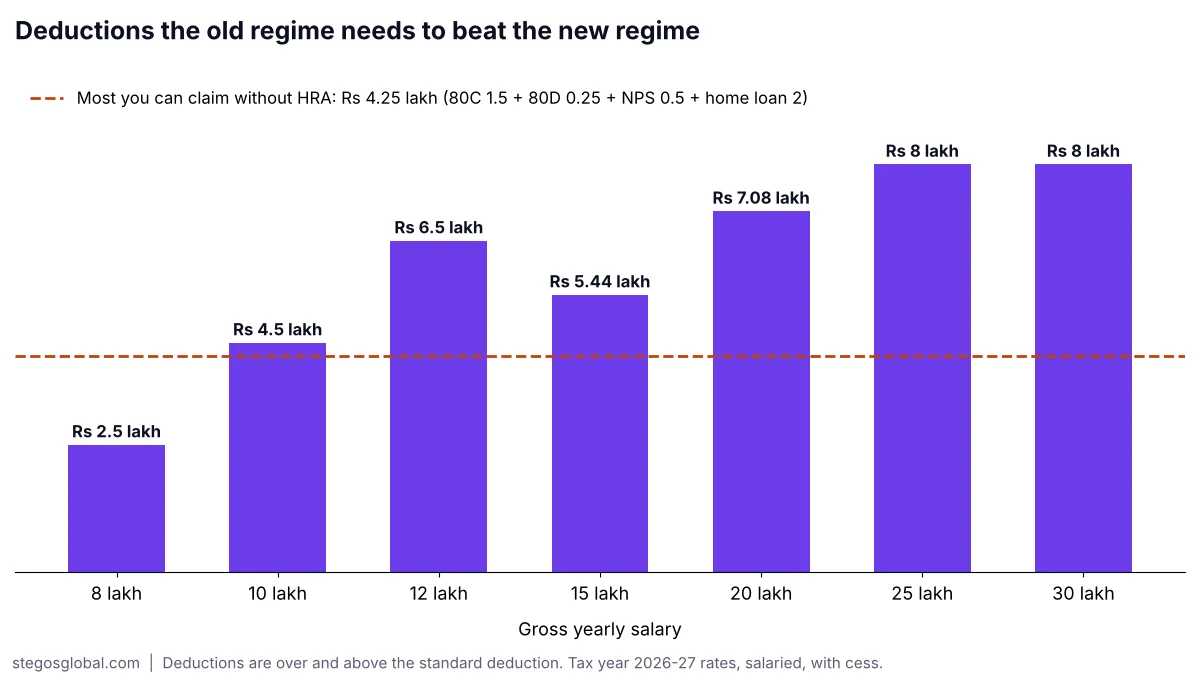
How much deduction does the old regime need to win?
I worked this out by solving for the deduction at which both regimes give the same tax, for a salaried person with only a standard deduction in the new regime. The figures include 4 percent cess.
| Gross yearly salary | Tax in the new regime | Deductions the old regime needs to match it |
|---|---|---|
| Rs 8 lakh | Rs 0 | Rs 2.5 lakh |
| Rs 10 lakh | Rs 0 | Rs 4.5 lakh |
| Rs 12 lakh | Rs 0 | Rs 6.5 lakh |
| Rs 15 lakh | Rs 97,500 | Rs 5.44 lakh |
| Rs 20 lakh | Rs 1,92,400 | Rs 7.08 lakh |
| Rs 25 lakh | Rs 3,19,800 | Rs 8 lakh |
| Rs 30 lakh | Rs 4,75,800 | Rs 8 lakh |
The most you can usually claim without HRA is about Rs 4.25 lakh: 80C Rs 1.5 lakh, 80D Rs 25,000, NPS Rs 50,000 and home loan interest Rs 2 lakh. That is not enough to beat the new regime at any salary above Rs 10 lakh. HRA is what usually closes the gap, so renters in metro cities should do the sum rather than guess.
Two worked examples at Rs 15 lakh
New regime. Taxable income = Rs 15,00,000 – Rs 75,000 = Rs 14,25,000. Tax on the slabs = Rs 20,000 + Rs 40,000 + 15% of Rs 2,25,000 = Rs 93,750. Add 4% cess and you pay Rs 97,500.
Old regime, example A. You claim 80C Rs 1.5 lakh, 80D Rs 25,000 and NPS Rs 50,000. Taxable income = Rs 15,00,000 – Rs 50,000 – Rs 2,25,000 = Rs 12,25,000. Tax = Rs 12,500 + Rs 1,00,000 + 30% of Rs 2,25,000 = Rs 1,80,000. With cess you pay Rs 1,87,200. The new regime is cheaper by about Rs 89,700.
Old regime, example B. You also pay Rs 2 lakh of home loan interest and claim Rs 1.2 lakh of HRA. Taxable income falls to Rs 9,05,000. Tax = Rs 12,500 + 20% of Rs 4,05,000 = Rs 93,500. With cess you pay Rs 97,240, almost the same as the new regime.
Run it with your own numbers
Enter your gross salary and the deductions you really claim. The calculator applies the slabs, the rebate and the marginal relief above. The numbers in the boxes are the Rs 15 lakh example A.
How to choose and how to tell your employer
- Run the calculator with the deductions you actually have proof for, not the ones you plan to buy.
- Do not buy a product only to get a deduction. A tax saving is not worth a bad investment.
- Tell your employer which regime you want at the start of the year so that TDS is cut correctly. If you do not, the new regime applies by default.
- If you have no business income, you can normally choose again each year when you file the return. If you have business or professional income, the rules for switching are stricter, so ask a chartered accountant.
- Keep the proofs (rent receipts, insurance premium receipts, loan interest certificate) even if you choose the new regime this year.

Frequently asked questions
Is income up to Rs 12 lakh tax-free?
Taxable income up to Rs 12 lakh is tax-free in the new regime because of the Rs 60,000 rebate. For a salaried person, add the Rs 75,000 standard deduction and the gross salary limit is Rs 12.75 lakh.
Is the rebate available under the old regime?
Yes, but it is only Rs 12,500, and only if taxable income is Rs 5 lakh or less.
Can I claim HRA in the new regime?
No. HRA exemption, 80C, 80D and self-occupied home loan interest are not allowed in the new regime.
Does the Income-tax Act 2025 change my tax?
Not the rates. It changes section numbers and terms, such as “tax year”. Form 26AS is renamed Form 168, according to one tax-calculator site, so look for the new names on the portal.
Sources
View sources (5)
| Source | What it was used for |
|---|---|
| Income Tax Department, “Rates of income tax for individuals” (assessment year 2026-27) incometax.gov.in | new and old regime slabs, 87A rebate of Rs 60,000 and Rs 12,500, 4% cess (checked 25 October 2026). |
| CAclubindia, “New Tax Regime FY 2026-27 caclubindia.com | complete slab, rebate and marginal relief reference” (6 October 2026): slabs unchanged by Budget 2026, standard deduction, marginal relief near Rs 12.71 lakh. A secondary source. |
| CalcGuru, “Did the Income-tax Act 2025 change your tax rate?” calcguru.in | what changed on 1 April 2026: sections, terms and forms, not rates. A secondary source. |
| TaxQueries, “New tax regime deductions taxqueries.in | allowed vs not allowed, AY 2026-27″ (July 2026): deductions allowed and not allowed in the new regime. A secondary source. |
| SalaryBox, “Old vs new tax regime for salaried employees, FY 2026-27” salarybox.in | old regime standard deduction and deduction limits, HRA rule. A secondary source; its worked figures were recalculated. |